


The garnet stone is not a single mineral but a group of related minerals with a Mohs hardness of 6.5 to 7.5. Most people mean the dark red kind, but it also comes in orange, yellow and green. It is the birthstone for January and, by tradition, stands for loyalty and friendship. At By Carola, it comes as a cylinder or teardrop necklace from €90.
A garnet stone looks like a seed from a pomegranate, and that is exactly where its name comes from. People have worn it since the Bronze Age, from the pharaohs of Egypt to the jewelry of the 19th century.
Here is what a garnet is, why it is not always red and what tradition says about it. You will also see where it comes from and how to care for it.
“In the shade, a garnet looks almost black. Only in the light does it show how red it is.”
I. The garnet stone: a whole family of minerals.
In mineral terms, garnet is a group name. It covers several related silicates that all crystallize in the cubic system. Five species matter for jewelry: pyrope, almandine, spessartine, grossular and andradite.
The dark red garnet most people know sits between almandine and pyrope. It has no cleavage, so it can be cut and polished smoothly. With a Mohs hardness of 6.5 to 7.5, it is harder than turquoise but softer than ruby and sapphire.
Its name comes from the Latin word for pomegranate. Small red garnets recall its seeds.
Fact sheet
Hardness and species according to the Gemological Institute of America (GIA).
II. Garnet is not always red: the species at a glance.
Red garnet is the best known, but the family is far more colorful. The table shows the five species that matter in jewelry and what they look like.
The main garnets
| Species and color | At By Carola |
|---|---|
| Pyrope and almandine: dark red to purplish red, known from Bohemia as Bohemian garnet | Cylinder and teardrop, €90 to €95 |
| Spessartine: orange to yellow | not in our range |
| Grossular: colorless through yellow and orange to green, including green tsavorite | not in our range |
| Andradite: yellow to green, including green demantoid | not in our range |
Species and colors according to GIA. Very rarely, there are garnets that change from blue to purple depending on the light.
Our stones belong to the red series. In the shade they look deep and dark, and when light passes through, they glow warmly. With gold, the red looks soft; with silver, it looks clearer.
III. Garnet meaning: by tradition, it stands for loyalty.
By tradition, garnet stands for loyalty, friendship and constancy. Some believe it brings good fortune and wealth. These are traditions, not promises. Few stones have made history for so long.
Where garnet made history
| Where and when | What happened |
|---|---|
| Bronze Age | Garnet is used as a gemstone and as an abrasive. |
| Ancient Egypt | Necklaces set with red garnets adorn the pharaohs. |
| Ancient Rome | Signet rings with carved garnets press the seal into the wax of important documents. |
| Middle Ages | Clergy and nobility prefer red garnets. |
| Bohemia, 19th century | Red pyrope from Bohemia becomes the fashionable stone of its time. |
History according to the Gemological Institute of America (GIA).
That makes it a lovely gift: giving garnet means giving a stone that people have worn for thousands of years and linked with loyalty.
IV. Today, much of the garnet comes from Africa.
Important sources are Namibia and Tanzania for orange spessartine, and Kenya, Tanzania and Madagascar for green tsavorite. Other deposits lie in Myanmar, Brazil, India and Sri Lanka.
Garnet became famous in Bohemia, though. In the 19th century, the popular red pyrope came mainly from there, in the west of what is now the Czech Republic.
As a birthstone, garnet belongs to January. It was already on the first standardized list of 1912 and is still the stone for this month. Anyone born in January is a Capricorn or an Aquarius, so it suits both signs as a month stone. You will find all pieces for the month on the page January birthstone, and the stones of the other eleven months in the guide Birthstones by month.
V. Wearing, giving and caring for garnet.
We offer garnet in two shapes: as a slim cylinder with a hexagonal cross-section and as a smoothly polished teardrop of about 13 to 14 mm. Both hang on a fine necklace in 925 sterling silver or 14K gold filled, in 40 or 45 cm (15.7 or 17.7 in).
As a gift, it suits a January birthday, and all year round as a sign of loyalty and friendship.
Every piece comes in a jewelry box with a card and a polishing cloth, and we add a gift note free of charge. For Christmas 2026, we recommend ordering by Dec 16 for Germany. All dates are on the page Gift a necklace with meaning.
From the Signature collection
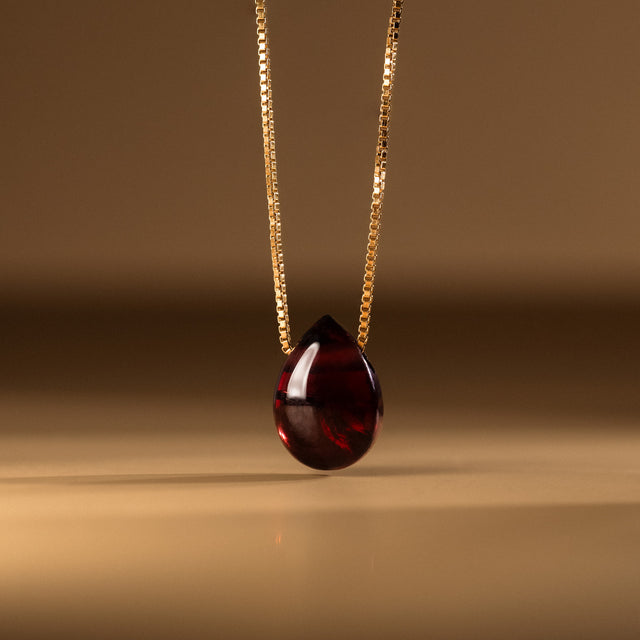
Teardrop Garnet Necklace
Teardrop garnet, about 13 to 14 mm, smoothly polished. In 925 sterling silver or 14K gold filled.
€90 to €95
On care: with a hardness of 6.5 to 7.5, garnet is sturdy but softer than ruby and sapphire. Store it dry and apart from harder jewelry. Clean it only with lukewarm water, a little soap and a soft brush, never in an ultrasonic cleaner and never with steam. Protect it from strong heat and sudden changes in temperature. How to keep the chain itself clean is explained in the article How to clean silver jewelry in six simple steps.
Good to know
Four things about our garnet.
01
Genuine garnet.
No red glass and no plastic. Stone and shape are listed in the product details.
02
Two shapes.
A slim cylinder or a smooth teardrop, every stone picked by hand, one by one.
03
Made by hand.
Every necklace is made in Germany after you order. By Carola has been around since 2019.
04
Ready to give.
A jewelry box, a card and a polishing cloth are included. The gift note is free.
Garnet is a stone for winter and for every day after. It is sturdy, warm in tone and has been in use since the Bronze Age.
In January it is the birthstone, and as a sign of loyalty it suits the whole year.
Carola
You will find garnet and all other birthstones under birthstone necklace. All necklaces with genuine gemstones are in the Signature collection.
View Signature


