Turquoise is a blue to blue-green stone made of copper, aluminum and phosphate, with a Mohs hardness of 5 to 6. It is the classic birthstone for December and, by tradition, stands for protection. Its blue comes from copper, and green tones come from iron. At By Carola, it comes as a teardrop on a fine necklace from 102 USD.
A turquoise stone looks like a piece of sky and yet comes from dry regions. People have worn it for thousands of years, in Egypt, in Persia and in the American Southwest.
Here is what it is, where its color comes from and what tradition says about it. You will also see how it differs from the other two December stones and how to recognize real turquoise.
In this article
- I.The turquoise stone: a copper mineral from dry regions
- II.The color: copper makes it blue, iron makes it green
- III.Turquoise meaning: by tradition, it stands for protection
- IV.Three stones for December: turquoise, tanzanite and zircon
- V.Real turquoise shows lively color and irregular veins
- VI.Wearing, giving and caring for turquoise
“Turquoise comes from the desert and looks like the sky above it.”
I. The turquoise stone: a copper mineral from dry regions.
In mineral terms, turquoise is a hydrous phosphate of copper and aluminum. It forms where the climate is dry and copper-bearing water seeps through the rock over a long time. That is why the well-known deposits lie in deserts and semi-deserts.
Turquoise has come from Nishapur in Iran for more than a thousand years. In the United States, it is mined mainly in Arizona and Nevada today. The largest amount now comes from China, above all from Hubei Province. That is typically where the turquoise in our necklace comes from, too.
Its name comes from French and means Turkish stone, because it reached Europe by way of Turkey.
Fact sheet
Hardness according to the Gemological Institute of America (GIA).
II. The color: copper makes it blue, iron makes it green.
Two metals decide the tone. Copper colors the stone blue, and iron pulls it toward green. Depending on where it was found, a stone sits closer to sky blue or closer to blue-green. Both are turquoise.
The dark veins that run through many stones are called matrix. They are remnants of the rock in which the turquoise grew. Some people like it with no veins at all, others precisely because of the pattern. No two stones are alike.
The stone is opaque and has a silky luster more than a sparkle. Next to silver its blue looks cool and clear, next to gold it looks warmer.
III. Turquoise meaning: by tradition, it stands for protection.
Hardly any stone has gathered so many stories. The table shows five of them, from ancient Egypt to the American Southwest.
What people have seen in turquoise
| Where and when | Tradition |
|---|---|
| Egypt, more than 3,000 years ago | Turquoise adorns the funerary mask of Tutankhamun. |
| Europe, from the 13th century | It was said to protect its wearer from falling, especially from a horse. |
| Tibet | It is considered a national treasure, believed to bring good fortune and protect from evil. |
| Pueblo, American Southwest | Its color was said to come from the sky. |
| Apache | It was said to be found at the end of a rainbow. |
Traditions as recorded by the Gemological Institute of America (GIA).
All of these are traditions, not promises. They are still lovely for a gift: giving turquoise means giving a stone that people have linked with protection for thousands of years.
IV. Three stones for December: turquoise, tanzanite and zircon.
December has three birthstones. Turquoise was already on the first standardized list drawn up by American jewelers in 1912. Zircon was added in 1952, tanzanite in 2002. Some lists also name blue topaz.
The three stones of December
| Stone and color | Mohs hardness | At By Carola |
|---|---|---|
| Turquoise: blue to blue-green, opaque | 5 to 6 | Teardrop Turquoise Necklace, 102 to 107 USD |
| Tanzanite: blue to violet, transparent | 6 to 7 | not in our range |
| Zircon: often blue, also colorless, yellow or red | 6 to 7.5 | not in our range |
Hardness values according to GIA. Zircon is a natural mineral and not the same as cubic zirconia.
You will find all pieces for the month on the page December birthstone. The stones of the other eleven months are in the guide Birthstones by month.
V. Real turquoise shows lively color and irregular veins.
Turquoise is often imitated. Common stand-ins are dyed howlite or magnesite, as well as glass and plastic. Only a lab test is completely certain, but a few signs help when you take a close look.
Howlite is a white mineral with gray veins that takes dye easily. Dyed blue, it looks similar to turquoise at first glance.
What helps most is a seller who states the stone and its origin openly. We list both in the product details.
Four signs to check
Color
Lively, not the same everywhere
A completely even blue points more to dyed material.
Veins
Irregular, never repeating
Lines that look painted on are a warning sign.
Drill hole
Look for white spots
Dyed howlite or magnesite often lies underneath.
Price
Too cheap for real blue
Bright blue at a very low price is rarely turquoise.
VI. Wearing, giving and caring for turquoise.
We offer turquoise as a smoothly polished teardrop of about 13 to 14 mm on a fine necklace, in 925 sterling silver or 14K gold filled and in 40 or 45 cm (15.7 or 17.7 in). It goes with white, beige and denim and stands out even on a plain wool sweater.
As a gift it is an obvious choice in December, for a birthday or for Christmas. Every piece comes in a jewelry box with a card and a polishing cloth, and you can add a gift note free of charge. For Christmas 2026, we recommend ordering by December 16 for Germany. All dates are on the page Gift a necklace with meaning.
From the Signature collection
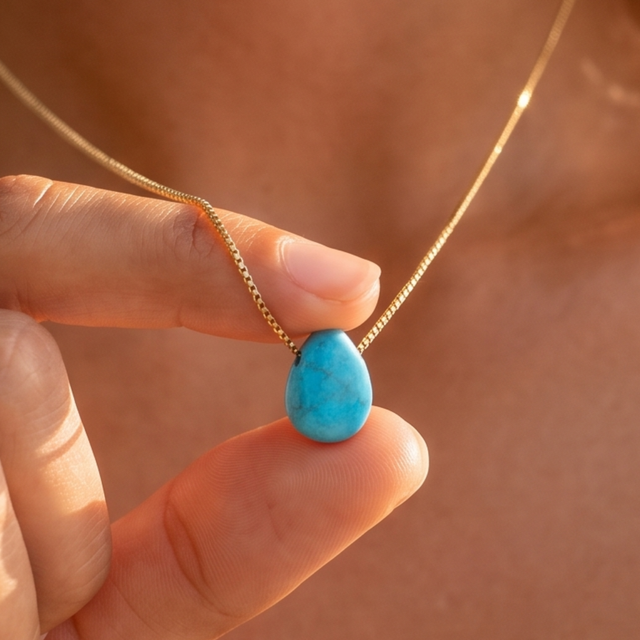
Teardrop Turquoise Necklace
Teardrop turquoise, about 13 to 14 mm, cut and polished. In 925 sterling silver or 14K gold filled.
102 to 107 USD
On care: with a hardness of 5 to 6, turquoise is softer than quartz. Store it dry and apart from harder jewelry. Avoid prolonged contact with salt water, chlorinated water, perfume, creams and harsh cleaners. It does not tolerate ultrasonic cleaning, steam, strong heat or long direct sun. How to keep the chain itself clean is explained in the article Caring for silver properly.
Good to know
Four things about our turquoise.
01
Real turquoise.
No dyed howlite and no pressed imitation. Stone and origin are listed in the product details.
02
Two metals, two lengths.
925 sterling silver or 14K gold filled, 40 or 45 cm (15.7 or 17.7 in).
03
Made by hand.
Every necklace is made in Germany after you order. By Carola has been around since 2019.
04
Ready to give.
A jewelry box, a card and a polishing cloth are included. The gift note is free.
A turquoise stone is not a loud stone. It is blue, a little green, sometimes veined, and it has more history than most gemstones.
It suits December especially well. The rest of the year, too.
Carola
You will find turquoise and all other birthstones under birthstone necklace. All necklaces with genuine gemstones are in the Signature collection.
View Signature